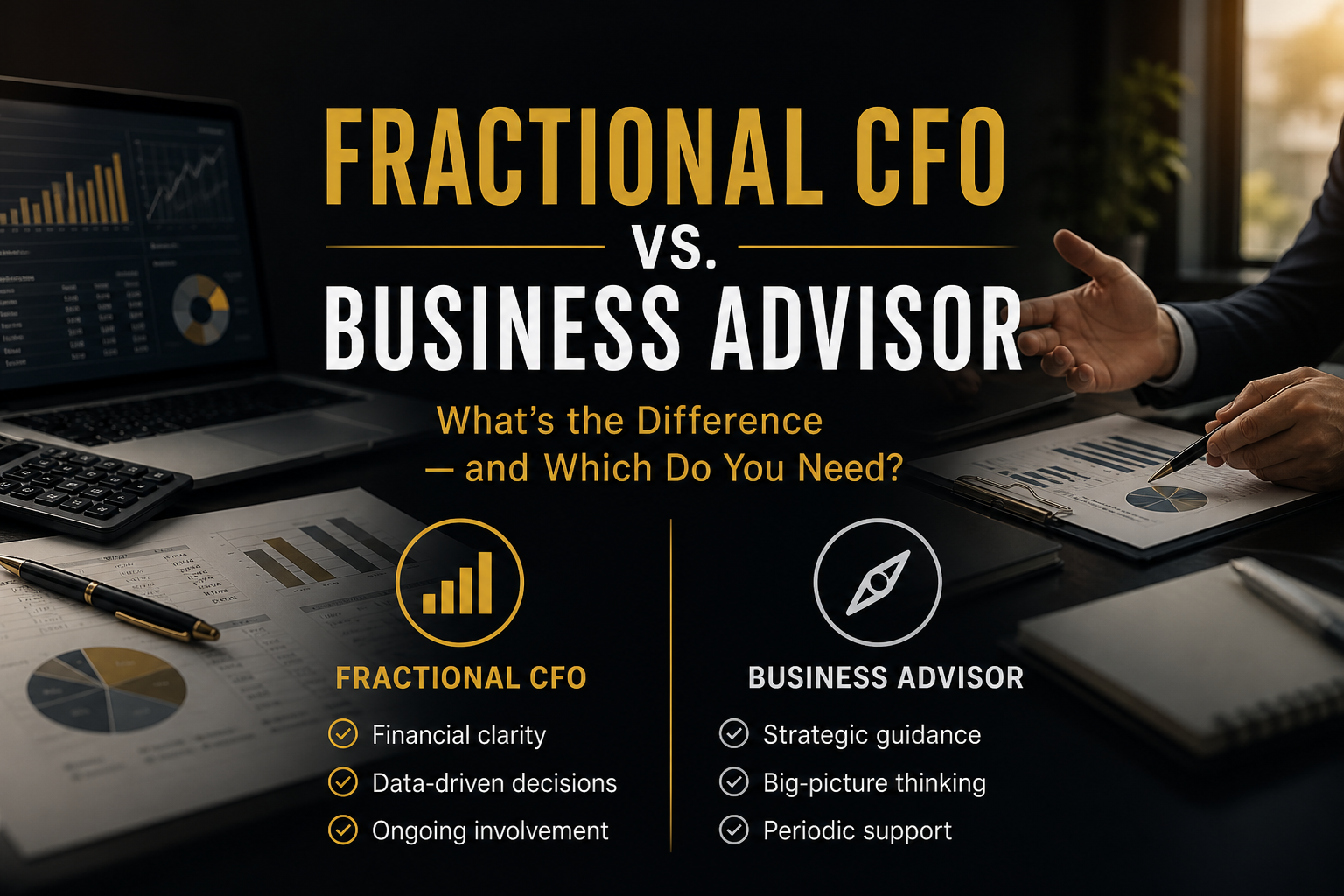
What’s the Difference (and Which Do You Need)?
If you’re a business owner looking to grow, improve profitability, or simply get better control over your numbers, you’ve probably come across two roles:
- Fractional CFO
- Business Advisor
At first glance, they can sound similar – and in some ways, they are. Both are focused on helping you make better decisions and improve your business.
But the way they approach those goals, and the level of involvement they bring, can be very different.
Understanding that difference can help you choose the right support at the right time.
What Is a Fractional CFO?
A fractional CFO is an experienced financial leader who works with your business on a part-time or contract basis.
Instead of hiring a full-time CFO, you gain access to high-level financial expertise, and at a level that fits your business.
A fractional CFO typically:
- Owns or oversees your financial function
- Builds and manages financial reporting systems
- Develops budgets and forecasts
- Analyzes profitability and cash flow
- Supports strategic decisions with financial modeling
- Works closely with ownership on an ongoing basis
In short:
A fractional CFO helps you understand not just what is happening financially, but why and what to do about it.
What Is a Business Advisor?
A business advisor is a broader role focused on helping you improve overall business performance.
They may provide guidance on:
- Strategy and growth planning
- Operations and efficiency
- Leadership and decision-making
- Market positioning
- General problem-solving
Business advisors are often brought in to provide perspective and guidance, rather than ongoing operational ownership.
In many cases:
A business advisor helps you see the path forward, but may not build the financial infrastructure to support it.
Key Differences at a Glance
| Area | Fractional CFO | Business Advisor |
| Primary Focus | Financial leadership | General business strategy |
| Involvement | Ongoing, hands-on | Periodic, advisory |
| Data & Reporting | Builds and owns financial systems | Reviews information provided |
| Decision Support | Quantifies decisions with financial modeling | Provides strategic input |
| Accountability | Often responsible for financial outcomes | Typically not accountable for execution |
| Depth | Deep financial expertise | Broad business perspective |
Where They Overlap
Both roles:
- Help you make better decisions
- Bring outside perspective
- Identify opportunities for improvement
- Support business growth
In fact, many strong fractional CFOs (myself included) naturally operate as both financial leaders and business advisors.
But the difference lies in how those insights are created and executed.
When You Need a Fractional CFO
A fractional CFO is the right fit when:
- You don’t fully trust or understand your financials
- You need better visibility into profitability
- Cash flow feels unpredictable
- You’re making important financial decisions without clear data
- You’re growing and need financial structure
- You want someone actively involved in your business each month
This is especially true if you’re asking:
“Where is the money going?”
“Are we actually profitable?”
“Can we afford to grow?”
When You Need a Business Advisor
A business advisor may be the right fit when:
- You need help thinking through strategy
- You want guidance on growth or direction
- You’re working through a specific challenge
- You need an outside perspective but not ongoing involvement
If your financials are already strong and reliable, an advisor can help you maximize what’s already working.
The Real Answer: It’s Not Either/Or
For many businesses, the best solution isn’t choosing one over the other it’s finding someone who can bridge both roles.
Because here’s the reality:
Strategy without financial clarity is guesswork.
Financial data without strategic context is underutilized.
The most impactful support comes from combining:
- Clear financial insight (CFO)
- Strategic thinking (Advisor)
How Osprey Advisory Approaches This
At Osprey Advisory, we don’t separate these roles –> we integrate them.
As a fractional CFO, the goal isn’t just to deliver reports. It’s to:
- Translate financial data into clear business insights
- Identify opportunities to improve profitability
- Help you make confident decisions
- Support your long-term growth strategy
That’s where real value is created.
Final Thoughts
Choosing the right support depends on where your business is today and where you want it to go.
If you need:
- Better financial visibility
- Stronger decision-making data
- Ongoing financial leadership
A fractional CFO is likely the right next step.
If you’re unsure, a good place to start is simply asking:
“Do I need better advice, or better financial clarity?”
Often, the answer is both.
Need help gaining clarity and improving profitability?
Let’s have a conversation about where your business is today –> and what it needs next.